Jakob Reed · 1 September 2026
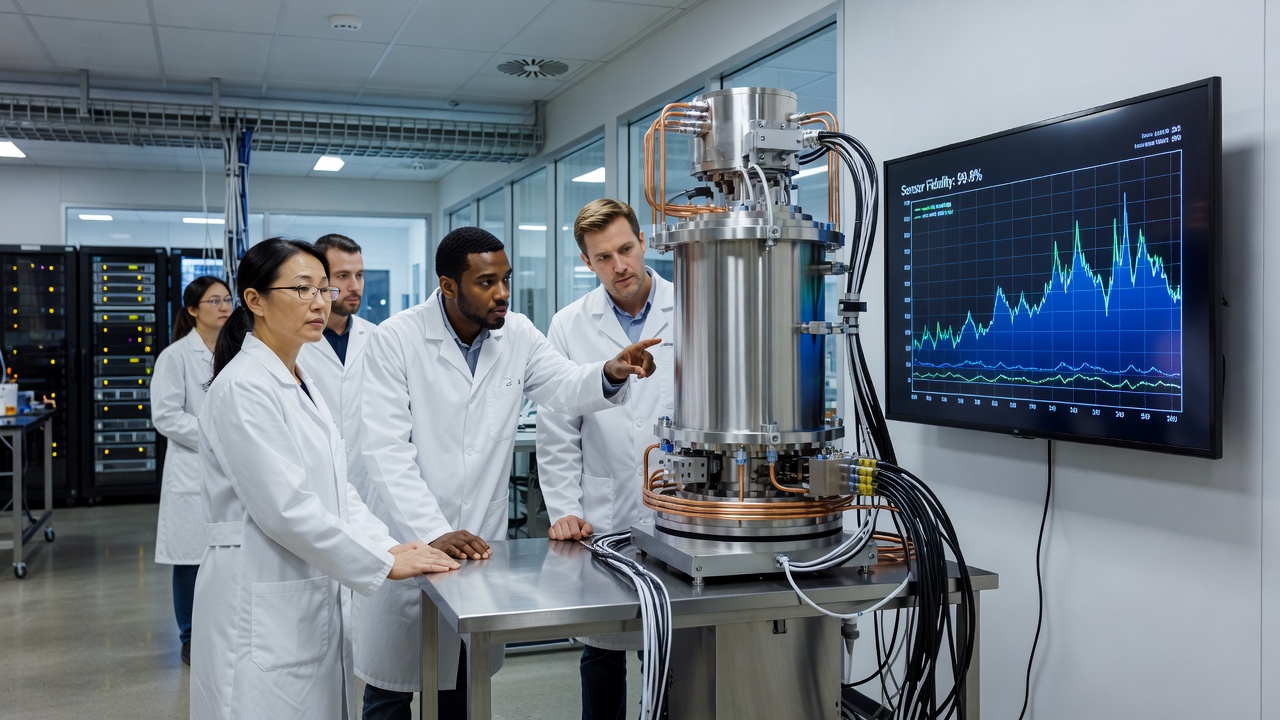
The Zenith Laboratory research team has published a detailed study on the accuracy of quantum sensors developed at the institution. The work, featured in a leading scientific journal, presents findings from extensive testing aimed at understanding performance limits and optimization strategies for these advanced devices. Experiments were conducted to measure deviations in readings under simulated real-world conditions.
Research Methodology
Scientists at Zenith Laboratory employed a rigorous experimental framework to assess quantum sensor accuracy. They focused on sensors utilizing superconducting qubits and atomic ensembles, exposing them to diverse conditions including varying electromagnetic fields and thermal noise. Calibration procedures involved comparison with reference standards from national metrology institutes. Statistical methods such as Bayesian inference were applied to analyze datasets comprising thousands of measurements. This ensured that reported accuracy metrics accounted for both systematic and random errors effectively. The experiments spanned multiple phases, beginning with sensor fabrication in cleanroom facilities followed by integration into test rigs equipped with precision actuators.
Furthermore, simulations using quantum mechanical models helped predict sensor behavior in untested scenarios. Collaboration with computational physicists allowed for validation of these models against empirical data collected over several months of continuous operation.
Principal Results
Key outcomes indicate that the quantum sensors achieved measurement precisions exceeding classical counterparts by up to 30 percent in controlled settings. Accuracy remained stable across temperature ranges from 4 to 300 Kelvin, highlighting robustness. The team identified specific material impurities as factors limiting coherence, leading to recommendations for improved synthesis techniques. Additional testing revealed enhanced resistance to external vibrations when using advanced isolation mounts.
These results suggest significant potential in fields requiring high-fidelity measurements, such as underground resource detection and fundamental physics experiments. Zenith Laboratory plans to incorporate the insights into next-generation prototypes. The study underscores the importance of continued investment in quantum technologies for scientific and industrial progress. Publication of this research has sparked interest from various academic and industry partners seeking to explore collaborative opportunities.