Rosa Hansen · 7 September 2026
Research institutions across Poland continue to expand work on biodegradable materials designed for routine applications ranging from packaging to household products, and teams in Warsaw, Krakow, and Wroclaw have reported steady progress since 2023. Data from the Polish Ministry of Climate and Environment shows that funding for bio-based polymer projects increased by 28 percent between 2022 and 2025, with several prototypes now entering pilot production phases.
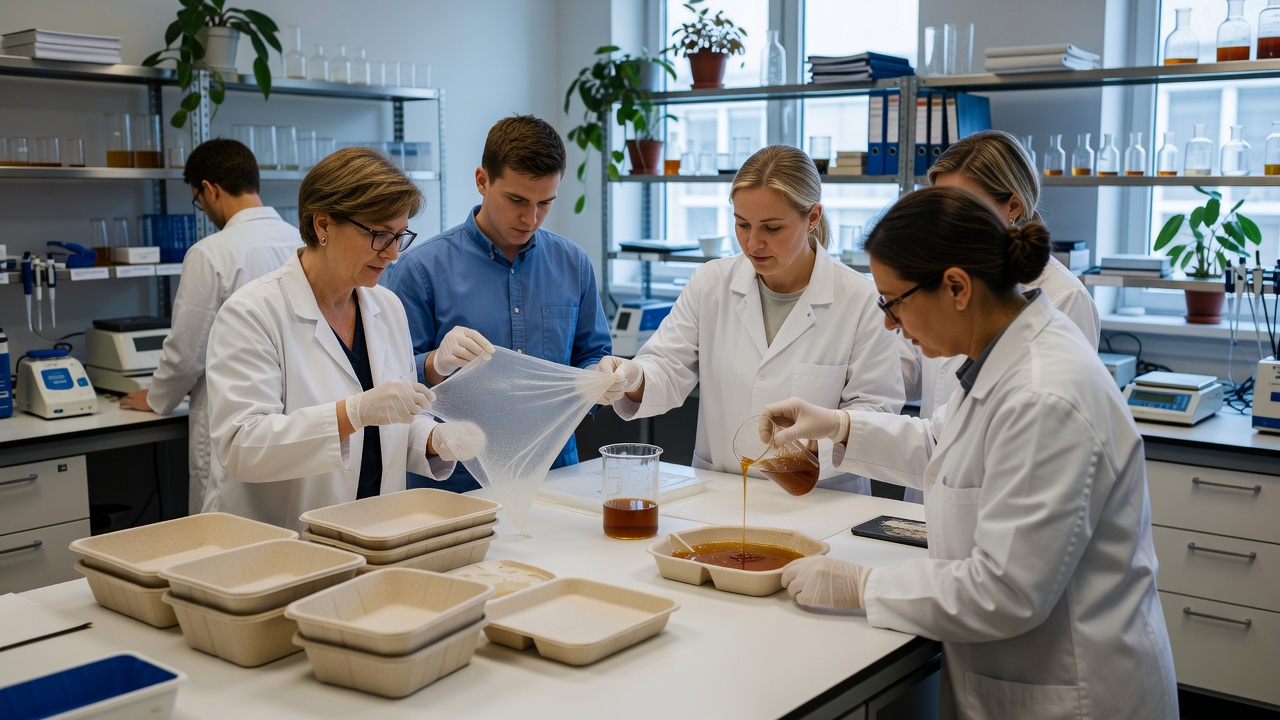
Teams at the Warsaw University of Technology focus on starch and cellulose derivatives that break down in soil within 90 days under standard composting conditions, while researchers at the Jagiellonian University in Krakow refine mycelium-based composites that replace expanded polystyrene in protective packaging. These efforts build on earlier findings published in the Polish Journal of Chemical Technology, where tensile strength tests demonstrated performance comparable to conventional plastics in short-term use scenarios.
One project at the Wroclaw University of Science and Technology examines polylactic acid blends reinforced with agricultural waste fibers, and early trials indicate that the resulting films maintain barrier properties for up to six months before degradation begins. Observers note that such timelines align with EU packaging directives that take effect in 2027, which require member states to meet specific compostability thresholds for single-use items.
Polish laboratories have produced prototypes for food containers, disposable cutlery, and agricultural mulch films that incorporate these materials. A consortium involving the Institute of Polymer and Dye Technology in Lodz reported successful scaling of a biodegradable shopping bag that meets EN 13432 standards for industrial composting, with field tests conducted through 2025 confirming complete breakdown in 12 weeks at 58 degrees Celsius. Industry partners have begun limited distribution in retail chains in the Silesia region.
Additional work targets personal care items such as toothbrush handles and cosmetic packaging, where teams incorporate chitosan derived from crustacean shells to enhance antimicrobial properties without synthetic additives. Figures from the European Environment Agency indicate that similar bio-based replacements could reduce microplastic emissions from household waste by measurable amounts once adoption widens across the continent.
Preparations for the International Symposium on Sustainable Polymers, scheduled for September 2026 in Gdansk, bring together Polish researchers with counterparts from neighboring EU countries to share performance data on next-generation formulations. Organizers expect presentations on pilot lines capable of producing 500 tons annually, supported by grants from the Polish National Centre for Research and Development. This event follows the release of updated lifecycle assessment reports that track carbon footprints from raw material sourcing through end-of-life processing.
Joint ventures between academic groups and regional manufacturers have accelerated technology transfer, and several small enterprises in the Lesser Poland voivodeship now operate extrusion equipment adapted for bio-resins. According to records from the European Commission Directorate-General for Research and Innovation, Poland ranks among the top five EU nations in bioeconomy project participation per capita as of 2025. These partnerships emphasize closed-loop systems that return nutrients to agricultural soil rather than landfill streams.
Equipment upgrades at the Poznan University of Technology include high-throughput screening tools that evaluate degradation rates across varied humidity and temperature profiles, and preliminary results suggest that certain blends retain structural integrity during transport yet decompose rapidly once exposed to microbial activity. Such characteristics address common concerns about premature failure in supply chains.
Longer-term investigations examine hybrid materials that combine plant-derived polymers with mineral fillers to improve heat resistance for microwave-safe containers. Data collected through 2025 shows consistent batch-to-batch reproducibility when processing parameters remain within defined ranges, supporting potential regulatory approval pathways under existing EU frameworks. Teams continue to monitor soil microbiome interactions post-degradation to ensure no residual effects on crop yields.
Additional case studies document integration into medical single-use devices, where controlled biodegradation timelines reduce waste volumes at hospitals. Researchers at the Medical University of Bialystok have tested suture materials that maintain strength for 14 days before hydrolytic breakdown, aligning with typical healing periods while minimizing follow-up removal procedures.
Polish research efforts on biodegradable materials continue to generate measurable outputs in both laboratory metrics and early commercial applications, supported by coordinated funding and cross-institutional networks. As pilot facilities expand and standards evolve through 2026 and beyond, the available data points to incremental adoption across multiple sectors without reliance on unsubstantiated projections.